
We are here for you
Thank you! Your submission has been received!
Oops! Something went wrong while submitting the form.
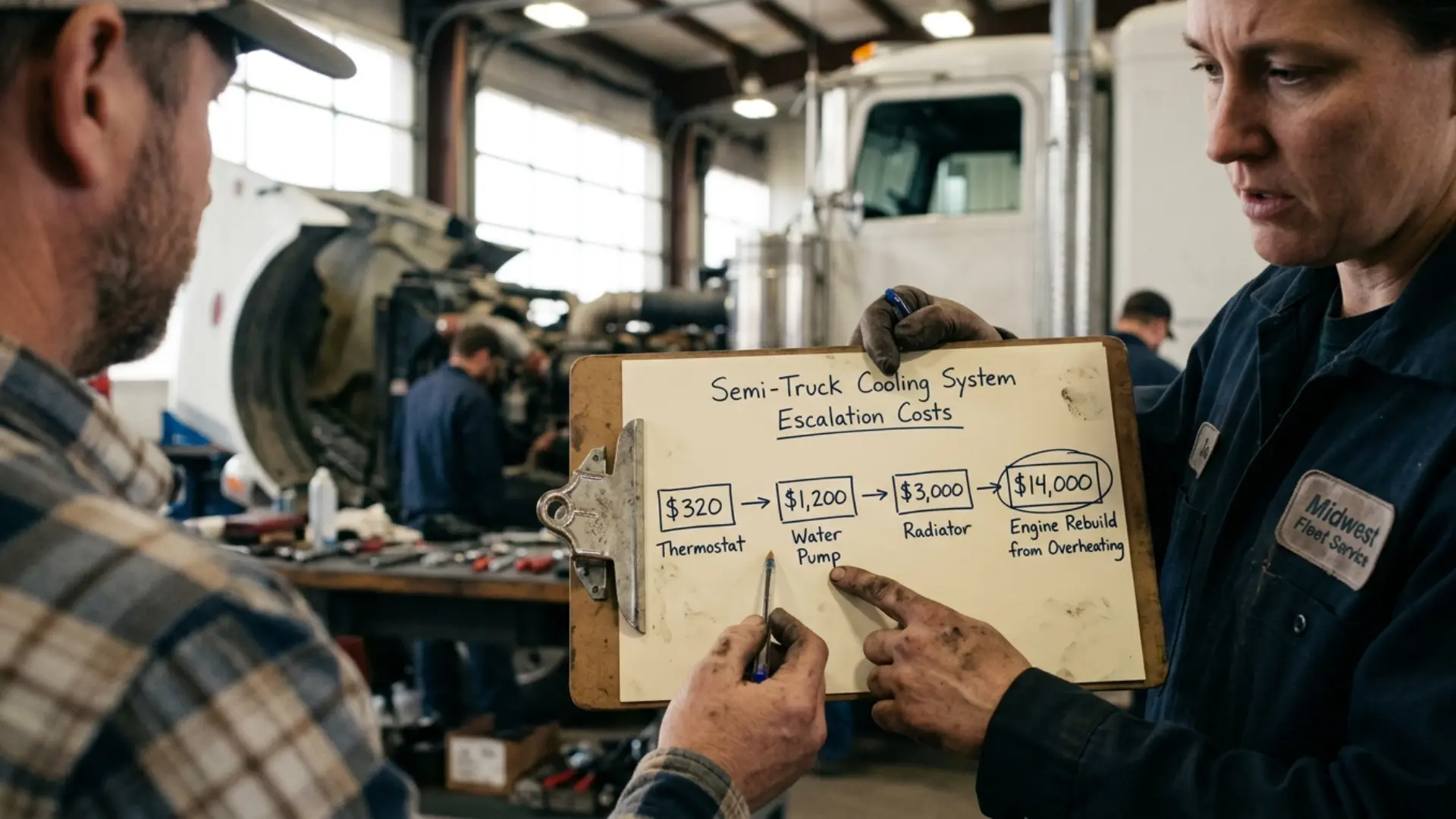

A temperature gauge creeping past normal on a grade in July is not an inconvenience. It is the early warning stage of a failure sequence that, left unaddressed, runs from a $320 component replacement to a $14,000 engine rebuild in the space of a single trip. Cooling system failures account for the third-largest category of commercial fleet roadside breakdowns, and unlike a tire or a fuse, the consequence of waiting is not linear. It accelerates.
A truck stranded with a blown head gasket from sustained overheating is a different category of event from a roadside assistance for semi trucks call for a flat tire. The repair cost is an order of magnitude higher, the downtime stretches from hours to days, and the engine damage may not be fully recoverable. Understanding what fails in a Class 8 cooling system, what each failure costs at each stage, and the service intervals that prevent the escalation is the difference between a $180 scheduled flush and a fleet manager explaining a $14,000 invoice to ownership.
A Class 8 diesel cooling system circulates coolant through the engine block to absorb combustion heat, routes it through the radiator where airflow releases that heat to the atmosphere, and returns cooled fluid to the engine in a continuous loop. The thermostat regulates flow based on engine temperature, the water pump drives circulation, and the fan or fan clutch provides supplemental airflow when road speed alone is insufficient.
The system's failure modes cascade because every component depends on the ones around it functioning correctly. A thermostat stuck closed prevents coolant from reaching the radiator at all, producing rapid overheating regardless of how well every other component is performing. A failing water pump reduces circulation even with a functioning thermostat and a clean radiator. A radiator clogged with debris cannot release heat even with perfect circulation. Each component is a potential single point of failure for the entire system, which is why cooling system maintenance requires attention to all of them rather than addressing whichever one happens to fail first.
Thermostats. The thermostat is the component most likely to fail silently. A thermostat stuck open allows the engine to run cooler than its design temperature, reducing combustion efficiency and fuel economy without an obvious warning sign. A thermostat stuck closed produces immediate and rapid overheating, often within minutes of normal operation. TruckClub's severe-duty cooling system analysis puts thermostat replacement at $200 to $600 including labor, with replacement intervals typically falling at 150,000 to 200,000 miles or sooner under severe duty conditions. The low cost relative to the consequence of failure makes proactive thermostat replacement one of the highest-return maintenance decisions in the entire cooling system, a $320 average repair that prevents a chain of cascading damage if the failure occurs at highway speed under load.
Water pumps. The water pump drives coolant circulation and typically fails from a combination of vibration, cavitation, contaminated coolant, and bearing wear over time. TruckClub's data puts water pump replacement at $600 to $1,200, with normal service life running 200,000 to 400,000 miles according to American Truckers LLC's 2026 maintenance cost guide. The water pump weep hole, a small drain designed to release coolant before a bearing fails catastrophically, is the early warning sign most fleets miss because it requires a physical inspection rather than a dashboard alert. Coolant weeping from this hole or an audible bearing noise both indicate replacement should happen proactively rather than waiting for complete failure on the road.
Radiators. Radiator failure modes include cracked tanks, clogged fins from accumulated debris, punctured cores, and internal scaling from degraded coolant. TruckClub's severe-duty data puts replacement at $1,200 to $3,000. Radiator core clogging is a gradual failure that reduces cooling efficiency by 30 to 60% before producing a complete failure, according to TruckClub's vocational truck cooling analysis, which means a fleet relying solely on overheating events to identify radiator problems is catching the failure at its most expensive and most disruptive stage rather than during routine inspection.
Coolant hoses. Hoses crack, bulge, and collapse internally as rubber compounds degrade from sustained heat and pressure cycling. A sudden hose failure produces rapid coolant loss and an emergency shutdown, frequently in a location with no warning. TruckClub's component cost data puts individual hose replacement at $150 to $500 each. The squeeze test, physically checking hose firmness at the midpoint during scheduled service, catches internal collapse before it produces a roadside failure, and is a standard inspection point during a complete coolant flush service.
Charge air coolers. The charge air cooler manages turbocharged intake air temperature and is increasingly relevant to overall thermal system load on modern emissions-compliant engines. Cracks at welds or vibration-induced leaks reduce boost pressure and heat rejection capacity, with replacement costs running $700 to $2,000 according to TruckClub's data. Charge air cooler issues are frequently misdiagnosed as engine performance problems rather than cooling system problems because the symptom (reduced power, increased fuel consumption) does not immediately suggest a thermal system cause.
Coolant is not an inert fluid that simply needs topping off when low. Modern Class 8 diesel engines use diesel-specific extended-life coolant formulations with nitrite inhibitors that protect wet-sleeve cylinder liners from cavitation corrosion, a failure mode specific to diesel engine architecture that does not occur in gasoline engines. These formulations require supplemental coolant additive testing at regular intervals to confirm the inhibitor package remains effective, because as the additives deplete, the coolant's ability to protect the cylinder liners and prevent internal corrosion degrades even while the fluid still appears visually normal.
Mixing coolant types, whether intentionally during a top-off with whatever is available or unintentionally during a component replacement, is one of the most common causes of accelerated internal corrosion. Different coolant chemistries are not always compatible, and mixing formulations can neutralize the inhibitor package entirely, leaving the system unprotected against the corrosion it was designed to prevent. The practical standard is confirming coolant type before any top-off and maintaining a single formulation across the fleet rather than allowing whatever is on hand at a given shop to be used inconsistently across trucks.
A properly executed coolant flush, beyond simply draining and refilling, is the point at which a technician has full access to inspect the entire system: radiator cap pressure rating, hose condition at every connection point, the coolant reservoir for cracks, and thermostat housing for external leaks. OxMaint's 2026 fleet radiator service guide recommends structuring these inspection points as a pass-fail checklist during every flush rather than leaving them to individual technician judgment, because the flush service is the one point in the maintenance cycle where the system is fully accessible and drained.
The standard interval for a complete cooling system flush is every 200,000 miles or two years, whichever comes first, according to multiple sourced fleet maintenance guides. Trucks operating in severe duty conditions, defined by frequent stop-and-go operation, sustained high idle time, heavy payload at or near GVWR, or operation in dusty and debris-heavy environments, require more frequent service because the cooling system is working harder under conditions the standard interval was not designed around.
For severe duty applications specifically, TruckClub's vocational truck cooling system analysis identifies the compounding factors directly: low airflow at low operating speeds reduces the ram air the cooling package was designed to receive, frequent PTO operation drives elevated idle RPM with increased fuel load and minimal airflow, and heavy payload increases combustion heat and coolant temperature simultaneously. A vocational truck spending most of its operating life at 5 to 25 miles per hour with frequent stops experiences cooling system stress that a standard highway interval schedule does not account for.
Between full flush intervals, a quarterly visual inspection covering coolant level, hose condition, radiator fin cleanliness, and any visible leaks catches developing problems before the next scheduled flush. This inspection requires no special tools and takes a technician under fifteen minutes per truck, making it one of the highest-value, lowest-cost inspection points in any PM program.
If your fleet's cooling system maintenance currently consists of topping off coolant when a driver notices it is low, the system is being managed reactively at exactly the point where reactive management is most expensive. OxMaint's 2026 fleet analysis documents that 23% of fleet breakdowns trace back to thermal system failures, the majority of which were preventable through scheduled flush and inspection intervals rather than the reactive top-off pattern. The escalation from a $320 thermostat to a $14,000 engine rebuild is not a worst-case scenario. It is the standard outcome when a cooling system is allowed to run on borrowed time.
A coordinated preventive maintenance program through a vetted nationwide network includes cooling system inspection and flush scheduling as a standard PM service line, not an item that depends on a driver noticing low coolant. If your fleet wants to understand what a structured cooling system maintenance schedule would look like for your specific truck count, duty cycle, and operating climate, reach out through the contact page with your fleet profile. The cost data above is the downside of leaving this on the informal schedule it is probably on right now.
This article draws on the following sources: