When a truck breaks down, most fleets don’t follow a process. This leads to expensive and chaotic operations.
The driver calls whoever they can reach, the person on the other end guesses what’s wrong, sends “someone who can go,” and you only find out what it really costs when the invoice arrives.
In an efficient operation, the first 15–20 minutes after a breakdown are structured. The driver usually knows exactly what to do and what not to do. The person answering the call knows what to ask. This is a productive process for the fleet, leaving no room for guesswork with pricing and scope predetermined. The decision is clear: tow, roadside repair, or drive to a safe parking.
This playbook lays out that structure, based on real experience in handling breakdowns in day-to-day operations:
- Driver protocol for the first 5–15 minutes
- The exact information your team must capture every time
- How to decide between tow, roadside, or moving the truck
- How to avoid being overcharged
- What to document so preventive maintenance and safety teams can actually fix the root causes.
Smart fleet owners and operations managers can use this playbook as a basis for their internal roadside breakdown SOPs.
What really happens in the first 15–20 minutes of a breakdown
When the processes are well-planned, the sequence looks like this:
- Driver reports the breakdown with basic info (unit ID, pictures, location, issue description, codes).
- The maintenance support technician should:
- Ask precise questions
- Collect photos, videos, and codes
- Determine the core problem (tire, or mechanical)
- After covering the basics, the next step should be the most cost-effective option:
- Send a mechanic on-site
- Call a tow truck
- Or, in limited cases, have the driver move to a nearby safe spot.
Once the information and photos are in, the best way to go can be reached within 15 minutes. Additionally, finding the solution and lining up the provider often takes approximately 20 minutes, even with a good system.
Eventually, the decision is made on a case-by-case basis:
- When it’s obvious from the onset that the problem cannot be fixed onsite, it’s best to skip calling a mechanic and go straight to organizing a tow. This skips unnecessary costs that would include both roadside service plus a tow.
- In case of a serious failure, it’s crucial to find a reliable mechanic because choosing the wrong provider becomes expensive twice: in cost and in time. The challenge here is finding the most qualified mechanic for that particular issue, as you cannot just send “whoever is available” and hope for the best.
Ultimately, these first 20 minutes make the real difference. When guided by a playbook instead of adrenaline and guesswork, this reflects in results and numbers.
Driver protocol: first 5–15 minutes after a breakdown
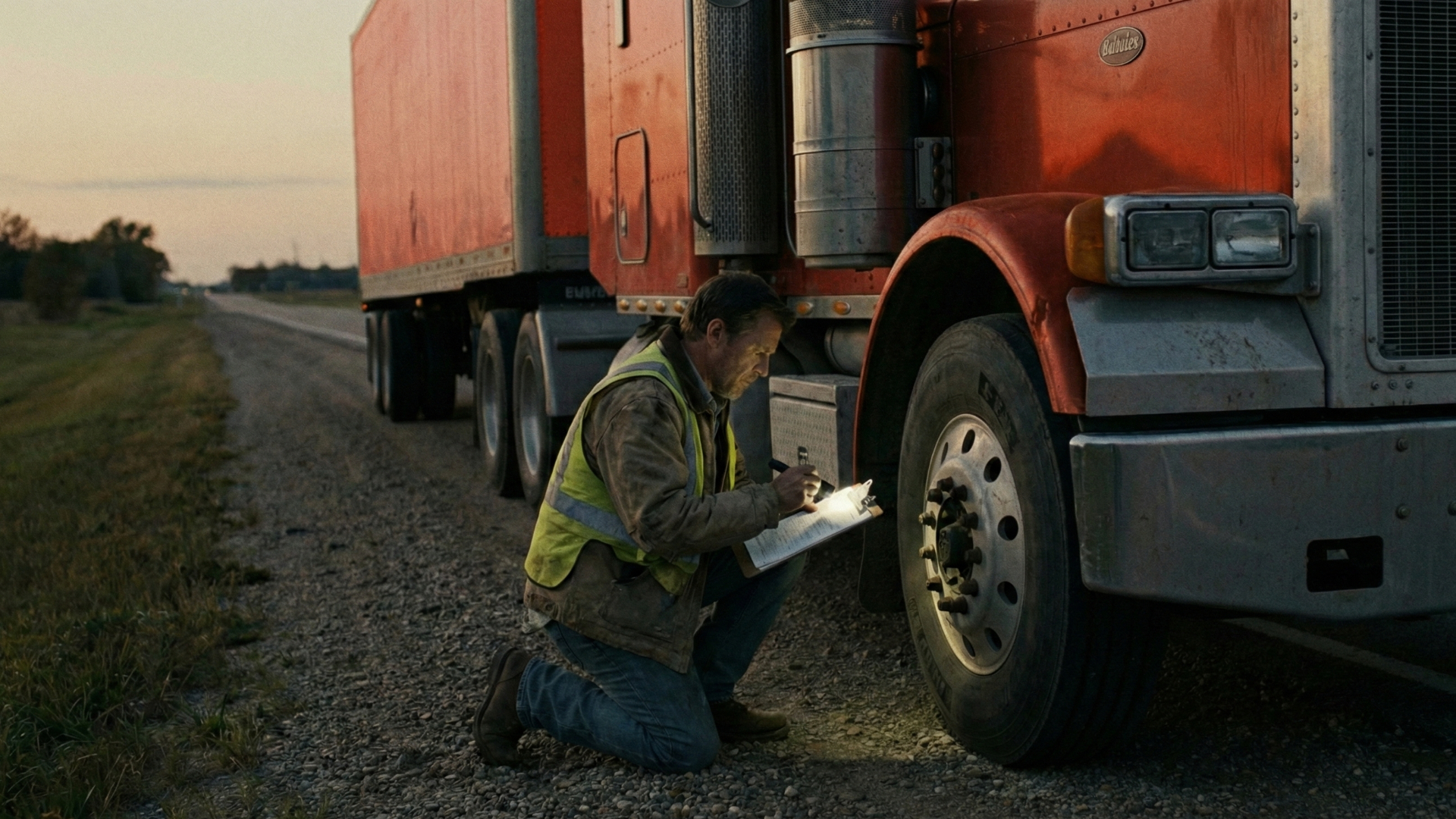
The driver’s job in a breakdown is not to become a mechanic. It’s to stay safe, make the scene visible, and deliver clear information.
Step 1: Get as safe and visible as possible
The very first priority is safety:
- Move the truck to the safest possible location, if it can move. Ideally off the highway (exit, truck stop, or secure parking). If not possible, as far onto the shoulder as you can, straight and visible
- Turn on hazard lights
- Put on a high-visibility vest
- Set up warning triangles according to your policy and local regulations
The driver should only start inspections once the scene is as safe as possible.
Step 2: Quick assessment – tire vs mechanical
The range of possible problems is huge, but most breakdowns fall into two buckets:
- Tire issues
- Mechanical issues
The driver’s role is to observe and report, not diagnose in detail.
When the issue is connected to tires, the following are a must:
- Check the position of the tire: this determines if the truck can move.
- If one drive or trailer tire blows, it’s sometimes possible to limp a short distance at low speed to a nearby truck stop (for example, up to ~5 miles, maximum ~10 miles) where the tire can be replaced safely.
- If a steer tire blows, the driver must stop immediately. The truck cannot be controlled safely, and further movement is not an option.
On top of checking the tires, also check for mechanical issues:
- Some failures allow the truck to move a short distance (a mile or two) to better parking.
- If there’s a critical internal mechanical failure that could cause significant damage if the truck were operated even briefly, the vehicle must stop immediately.
When assessing the situation, the driver should look for obvious signs:
- Oil leaks
- Fuel leaks
- Air leaks (hissing)
- Visible broken parts or severe damage
Other vital questions the driver should consider:
- Did it lose power?
- Did they hear any unusual noises?
- Were any warning lights active?
Once that quick assessment is done, the driver should get back inside the cab and stay out of the lane/traffic. There’s rarely a good reason to walk around on a busy road.
Step 3: Collect the essentials before or during the call
Before or while calling in, the driver should have:
- Unit ID for truck and trailer
- Exact location:
- Highway number and direction
- Nearest exit, mile marker, or landmark
- Or full address if at a customer or truck stop
- A short description of the problem:
- What happened - what the driver can observe visually
- How the truck behaved right before stopping
- Photos and/or videos:
- The damaged tire or component
- Any leaks or visible damage
- The dashboard with warning lights or codes
A well-coordinated team handles this regularly and effortlessly, even more when there are set procedures for both the drivers and the maintenance support team.
Working with experienced professionals who are well-connected with the right people makes it easier on another level.
What the fleet must capture on every breakdown call
Once the driver calls, whoever answers (day shift or after-hours) must take control of collecting information.
At a minimum, each breakdown record should include:
- Truck and trailer unit IDs, precise location, and type of issue ( tires, engine, fuel, air system/brakes, electrical/batteries, reefer/unit)
- Symptoms and behavior:
- Loss of power, won’t start, noise, smoke, vibrations
- Visible leaks (oil, fuel, coolant, air)
- Sudden vs gradual failure
- Evidence:
- Photos and/or videos from the driver
- Any codes or warning lights that the driver can read or capture
If the following information is missing, it leads to a delay and wastes time:
- Vague location (“somewhere on I-XX…”)
- No description of what happened right before the failure
- No photos, or photos that don’t show the actual problem area
If you don’t standardize these questions, every breakdown turns into a guessing game, and those guesses cost money.
Tow, roadside, or drive to safe parking: making the right call
Once the information is in, the person in charge needs to make the core decision:
- Is it safe and smart to drive a short distance to a safer parking?
- Should we send a roadside mechanic?
- Should we call a tow immediately?
When it’s acceptable to move the truck
You consider moving the truck when:
- The issue is limited and understood (e.g., one drive or trailer tire failure, minor leak without catastrophic risk).
- There is a safe parking location or truck stop within a short distance (ideally within ~5 miles, maximum ~10 miles).
- The truck can be driven slowly and carefully at low speed.
Even then, you decide conservatively: if there’s any serious doubt, you treat it as a non-driveable situation.
When to send a roadside mechanic
Roadside repair makes sense when:
- The truck is already in a safe or semi-safe location.
- The problem is realistically fixable on the roadside, such as:
- The estimated cost and time for roadside service is clearly better than towing to a shop.
You avoid sending a mechanic when the failure is obviously too deep or complex for roadside conditions to handle. Otherwise, you’ll just stack a tow bill on top of a useless service call.
When to go straight to the tow
Tow is the correct decision when:
- The truck is in a dangerous position:
- Tight shoulder
- Blind curve
- Heavy traffic with poor visibility
- The failure is critical:
- Internal mechanical failure, where driving risks major engine or driveline damage
- Steer tire blowout
- Brake system problem that compromises safety
- There is no realistic safe parking within a very short distance.
- Continuing to drive will almost certainly cause catastrophic damage or a safety risk.
When a mechanical part has clearly failed seriously, the answer is simple: tow service immediately, not “let’s see if it holds.”
5. What dispatch / after-hours should do during a breakdown
Once all key information is gathered, the fleet support needs to coordinate the entire process:
1. Confirm driver safety and posture
- Is the driver safe where they are?
- If possible, should they move to a better location? (Only if it’s safe.)
Safety is the first question, not an afterthought.
2. Review information and evidence
- Look at photos and videos.
- Look at the codes and dash information.
- Make a working assumption: tire vs mechanical vs fuel vs air vs electrical.
This is where you decide which type of vendor you need.
3. Choose the right vendor (not just the nearest one)
Dispatch should:
- Decide whether the situation calls for:
- Tire service
- General mechanic
- Specialized mechanic
- Tow
- Verify that the provider is:
- Legitimate
- Capable of handling the specific failure
- Reasonably responsive
Not every mechanic can do every job. Sending someone who doesn’t have the skills or equipment just adds more delay and cost.
Fleets that have access to a vetted nationwide truck repair network skip this problem entirely - the right type of provider is already confirmed before dispatch picks up the phone
4. Negotiate and confirm pricing before work starts
This is where many fleets lose money.
Before confirming the job, you should:
- Ask very clearly about:
- Call-out fee
- Labor rate (per hour)
- How they bill time (minimum hours, rounding)
- Mileage charges (to and from the truck)
- Parts pricing expectations
- Make sure they’re not quietly adding extra hours, mileage, or unnecessary parts and “diagnostics.”
This is where details matter. The difference between a controlled and uncontrolled bill is often the difference between one clear pricing conversation and none. In some cases, it might be $100; in others, the difference can easily be $1,000 or more.
Everything should be both confirmed verbally and backed up in writing (email, text, or official service document).
5. Monitor progress and keep everyone aligned
Once the vendor is dispatched:
- Check in regularly with both the driver and the mechanic/tow.
- Confirm ETA, arrival time, what was found on site, or any additional work being proposed.
Crucial thing to remember: the company should be the one to approve work and costs. Mechanics should understand that only the company (not individual drivers) can authorize work and spending, except in rare cases where you intentionally operate with owner-operators who approve their own maintenance.
6. The mistakes that turn breakdowns into disasters
Certain patterns repeatedly drive costs and frustration up:
- Acting in a rush without complete information
- Operations staff under pressure skip steps, assume instead of asking, and approve work that wasn’t necessary.
- Urgent does not mean you can’t spend 5 minutes on questions and photos.
- Sending the wrong type of provider
- A tire vendor to a clear mechanical issue, or a general mechanic to a deeply specialized problem, guarantees wasted time and money.
- Not aligning on price and scope
- No discussion of call-out, labor, mileage, or parts ahead of time.
- No written confirmation.
- Being “over-serviced” because no one challenged the quote or confirmed limits.
- Leaving a truck on the shoulder to “wait for morning.”
- You risk a police-ordered tow at premium rates.
- You also expose your driver and the public to more risk.
- Ignoring preventive maintenance
- If PM is done properly, breakdowns become much rarer.
- When PM is neglected, roadside events are frequent, and the same failures keep reappearing.
None of these is bad luck. They’re all process failures.
7. Documenting breakdowns so the fleet actually learns
Breakdowns are expensive, and the least you can do is learn from each one to prevent future unnecessary costs and improve how everything functions.
Every breakdown record should document:
- Root cause (as best as it can be determined):
- Tire condition
- Component failure
- Driver behavior
- External factors (road debris, collision, etc.)
- System/component involved:
- Tires
- Fuel
- Brakes/air
- Engine / mechanical
- Electrical / batteries
- Reefer
- Truck year and model, and patterns:
- The same kinds of failures often repeat on the same model year and configuration. That needs to be flagged.
- Driver vs equipment contribution:
- Did the driver ignore warning signs?
- Was the vehicle itself simply in poor condition?
- Timeline and cost:
- Time of breakdown, time of service arrival, time back in operation
- Itemized costs (service, tow, parts, lost time)
This information should then be reviewed regularly by:
- Maintenance / PM – to adjust intervals, inspection checklists, and component replacement strategies.
- Safety – to address behavior, training, and incident patterns.
- Operations – to refine routing, vendor lists, and decision rules.
Without this loop, you’ll keep paying for the same type of breakdown on the same trucks, in the same locations, year after year.
8. Simple breakdown checklists for drivers and dispatch
It all comes down to this. A playbook that companies can turn into something people use every day.
Driver breakdown checklist (first 15 minutes)
- Make the scene safe
- Move to the safest possible spot (exit/parking if feasible; otherwise, far onto the shoulder).
- Turn on hazard lights.
- Put on a high-visibility vest.
- Set up warning triangles.
- Do a quick visual check
- Check for:
- Think about what the truck did before it failed:
- Loss of power, noises, smoke, and warning lights.
- Collect information
- Truck and trailer unit IDs.
- Exact location (road, direction, nearest exit/mile marker or full address).
- Photos or video of:
- The damaged area
- Leaks or broken parts
- The dashboard and warning lights/codes
- Call the breakdown line/dispatch
- Stay in the cab unless explicitly told to exit, and it’s safe.
- Answer questions clearly and send photos/codes as requested.
- Do not authorize work or payments unless that is explicitly your role.
Dispatch/control center breakdown checklist
- Confirm safety and location
- Is the driver in a safe place?
- Should they move to a safer location if that’s still possible?
- Capture the full picture
- Unit IDs (truck + trailer).
- Precise location.
- Type of issue (tire, mechanical, fuel, air, electrical, reefer).
- Symptoms and behavior before the breakdown.
- Photos, videos, and any codes.
- Assess severity and decide: move, roadside, or tow
- Is it safe and reasonable to move a short distance to better parking?
- Is this fixable roadside?
- Does the situation demand an immediate tow?
- Select and brief the right vendor
- Choose between tire service, mechanic, specialized shop, or tow.
- Share all relevant photos and descriptions.
- Confirm they truly can handle this type of problem.
- Align on price and scope
- Confirm call-out fee, labor rate, minimum hours, mileage, and parts expectations.
- Get this in writing (email, text, or service ticket).
- Make it clear that only the company can approve work (except where owner-operators are explicitly responsible).
- Monitor and document
- Check in regularly with the driver and vendor.
- Confirm arrival time, findings, and any changes in scope.
- Log root cause, system, truck model/year, driver contribution (if any), timeline, and costs.
Used consistently, this kind of playbook doesn’t just make individual breakdowns cheaper. It turns roadside events from chaotic emergencies into manageable processes, and gives your fleet the data it needs to reduce how often they happen at all.
Some fleets choose to handle this in-house. But sometimes, it makes more sense to let professionals take over. The ones who actually created this playbook:
Millennials Maintenance brings clarity to these processes through hands-on experience, working with real fleets on the road.