

We are here for you
Thank you! Your submission has been received!
Oops! Something went wrong while submitting the form.
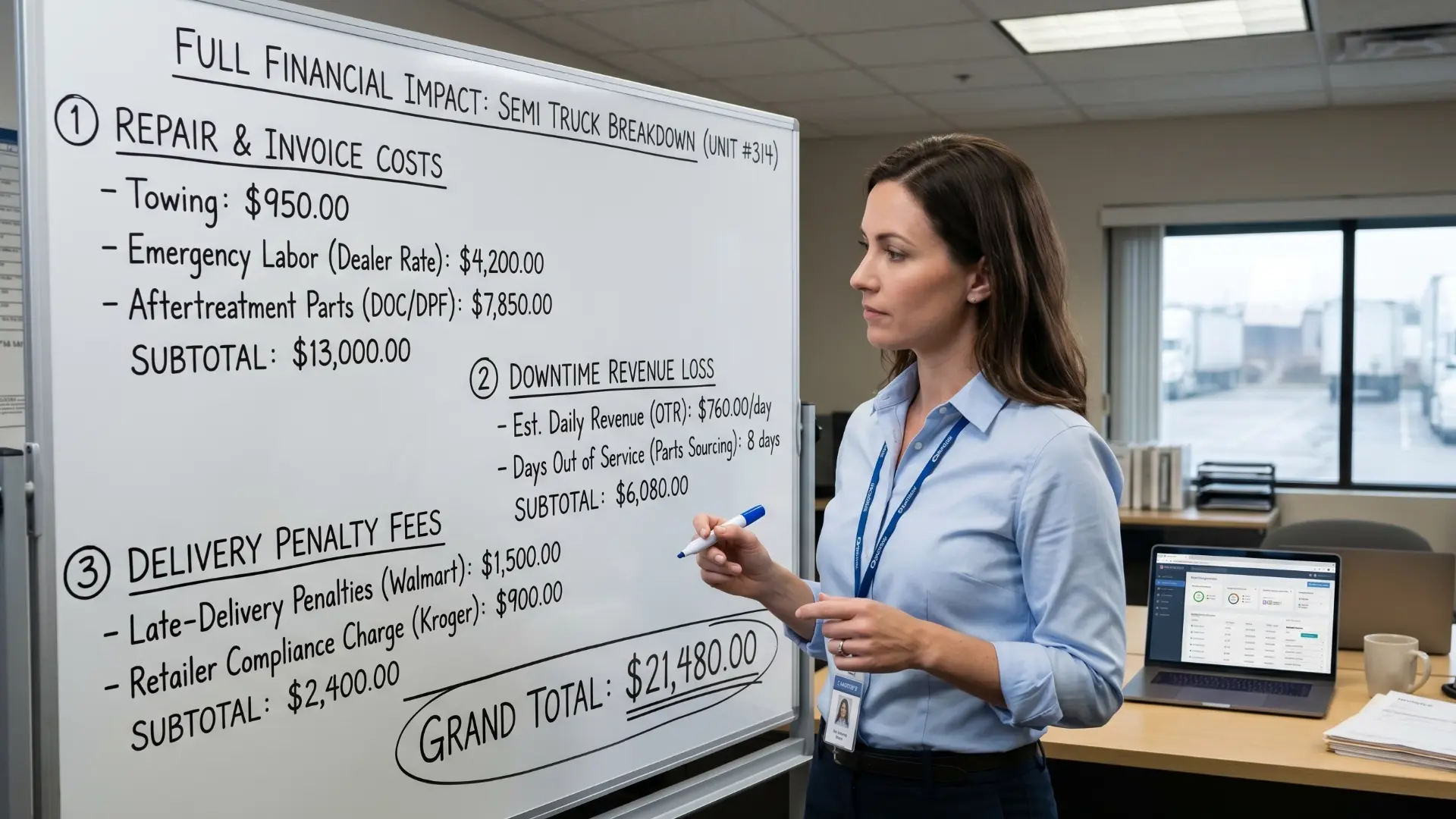


The towing invoice and the repair bill are what most fleet managers count after a breakdown. Add them up, file the paperwork, move on. But those two numbers represent only the portion of a breakdown event that generates a document. Everything else, the revenue the truck was not earning, the driver wages accumulating while the truck sat, the delivery penalty the shipper triggered, and the HOS clock that kept running even though the truck was not, does not appear on any invoice. It comes out of the margin, often silently, and it almost always exceeds the visible repair cost.
For a fleet running 20 to 50 trucks, the distinction between what a breakdown puts on paper and what it actually costs matters enormously when evaluating maintenance spend, vendor relationships, and how much a coordinated breakdown response is actually worth.
The visible costs of a breakdown are real and often higher than fleets budget for on unplanned events. Towing a disabled tractor-trailer runs $500 to $1,500 depending on distance, location, and time of day, with remote-area or after-hours events pushing significantly higher. Emergency repair labor at dealerships runs $150 to $250 per hour. Aftertreatment components, which are among the most common causes of modern Class 8 derates and shutdowns, carry parts costs that routinely push a single repair well past $5,000. OTR Performance, which tracks breakdown cost data across heavy-duty fleets, puts the typical cost of a single unplanned breakdown in the range of $3,000 to $9,000 before any of the non-invoice costs are factored in.
The emergency rate premium is a real and persistent part of that invoice total. A fleet with vetted shop relationships and pre-negotiated pricing pays a materially different labor rate than a fleet calling an unfamiliar shop from a highway shoulder at 11 PM. The difference between $125 per hour at a vetted partner shop and $225 per hour at a dealership dispatching emergency labor is not a rounding error across a multi-hour repair event. The pricing structure behind a breakdown response determines a meaningful portion of the invoice before a single bolt is turned. What that looks like in practice, and how the vendor selection model changes it, is covered in the article on commercial truck roadside assistance versus fleet coordination.
While the truck sits, it generates nothing. FleetNet America and the Technology and Maintenance Council of the American Trucking Associations put the average cost of unplanned downtime for a commercial truck at $448 to $760 per vehicle per day, a figure cited across multiple fleet industry sources including Ryder, Fullbay, and Trimble. That range reflects lost freight revenue, the operational overhead still accumulating on a non-earning unit, and the downstream disruption to dispatch planning.
The duration of a breakdown event is where this cost compounds. Trimble's fleet breakdown research found that 44 percent of fleets anticipate downtime of six hours or more from a single breakdown event, and 16 percent face disruptions exceeding 24 hours. A 24-hour event on a truck that would have run 500 revenue miles that day, at a loaded rate of roughly $3.50 per mile, represents $1,750 in gross revenue lost before the $448 to $760 daily downtime cost is added. Complex failures involving aftertreatment systems, transmission work, or parts that require sourcing from a dealer network can stretch into multi-day events. OTR Performance's fleet data puts the average at 8.7 days of unplanned downtime per truck per year, meaning a 25-truck fleet is absorbing the equivalent of 217 truck-days of lost earning capacity annually from unplanned events alone.
The practical floor for total downtime cost on a single breakdown runs $1,500 to $2,500 for a half-day event resolved quickly by a competent mobile tech. The ceiling, for a multi-day derate requiring a dealer visit and backordered parts, is considerably higher and directly tied to how fast the truck gets to the right shop.
A driver stranded on the shoulder is still on the company's payroll. The average trucking company pays drivers between $0.45 and $0.65 per mile in current market conditions, but drivers sitting at a breakdown are typically on an hourly guarantee or breakdown pay rate ranging from $150 to $250 per idle day depending on the carrier's structure. That is a fixed outgoing cost with no corresponding revenue generation.
The more significant driver-related exposure comes from what a breakdown does to the Hours of Service clock. Under FMCSA regulations, a driver has a 14-hour on-duty window and 11 hours of allowable drive time before a mandatory 10-hour reset. Time spent waiting at a breakdown counts against that 14-hour window. A three-hour breakdown that runs into hour eight of the driver's window leaves the driver with fewer than three hours of drivable capacity before the reset is required, regardless of how far they still need to travel. This forces either a 10-hour pause before delivery, a missed appointment window, or both. The clock does not stop because the truck broke down.
For time-sensitive freight, this dynamic often converts a single mechanical failure into a cascading schedule problem that affects not just the broken truck but other units in the fleet that need to cover or absorb the missed delivery.
Major shippers and retailers have built penalty structures into their carrier agreements that activate on missed or late delivery windows. Walmart fines suppliers up to 3 percent of a shipment's value for late or incomplete deliveries, according to published retail compliance data cited by Grocery Dive. Kroger and similarly sized retailers operate comparable fine structures. For a $50,000 load, a 3 percent penalty is $1,500 on top of every other cost the breakdown already generated.
Beyond formal fine structures, the less quantifiable but real cost is freight access. Brokers and large shippers track on-time performance rates at the carrier level. A carrier with a deteriorating on-time record, driven partly by breakdowns that pushed loads past delivery windows, faces rate pressure and load rejection that affects future revenue. The financial impact does not show up on a breakdown-specific invoice. It shows up in the rates the fleet can command six months later.
For fleets that want to understand how coordinated breakdown response, specifically the difference between a response that gets a truck moving again in three hours versus one that takes fourteen, directly affects delivery penalty exposure, the truck roadside assistance service page covers how dispatch-to-resolution timing works in a vetted network versus an ad-hoc emergency response.
The math is not complicated once the non-invoice costs are included. OTR Performance's calculation framework for a 25-truck fleet averaging two breakdowns per truck per year at $5,000 per incident in direct repair costs alone produces $250,000 in annual breakdown spend. Adding even a conservative estimate of one additional day of downtime revenue loss per event at $500 per day adds $25,000 to that number. Delivery penalties on a fraction of those events can add tens of thousands more.
For a 30-truck fleet, the gap between the industry average maintenance cost of $0.198 per mile and a well-maintained fleet running at $0.15 per mile runs to roughly $120,000 per year in preventable costs, as detailed in the fleet maintenance program performance article. That gap reflects the cumulative effect of deferred maintenance, reactive repairs, and the downstream costs that follow each unplanned event.
A breakdown that generates a $4,000 repair invoice and costs the fleet $1,500 in downtime, $300 in driver idle pay, and $750 in delivery penalties is actually a $6,550 event. The $4,000 on the invoice is what gets discussed in the post-breakdown review. The other $2,550 gets absorbed into the operating cost variance and rarely attributed to the specific event that caused it.
The repair cost on the invoice is not fixed for a given failure type. It is substantially determined by who shows up, at what rate, and whether parts are sourced through a relationship that carries negotiated pricing or through an emergency channel that does not. A carrier running without vetted vendor relationships accepts whatever rate the first available shop quotes during a live breakdown, with no prior negotiation and no accountability mechanism for what gets billed.
The article on predatory towing and commercial trucks covers the most extreme version of this dynamic, where ATRI documented an average towing invoice of $11,681 on events where the fleet had no pre-established vendor relationship and the tow company was dispatched by law enforcement from a rotation list. That ceiling is an outlier. But the underlying mechanism, that emergency rate structures apply whenever a fleet has no prior relationship with the vendor responding to a breakdown, operates at every price point, not just on towing events.
If your fleet is absorbing unplanned breakdown costs and the post-event reviews focus only on what showed up on the invoice, the true cost of those events is almost certainly higher than it appears. A coordinated preventive maintenance program that reduces breakdown frequency and a vetted nationwide truck repair network that controls what happens when breakdowns do occur address both sides of that cost exposure. If you want to understand what that looks like for your specific fleet size and operating footprint, reach out through the contact page. The conversation is more useful with your actual breakdown history and fleet profile in front of us.
This article draws on the following sources:



.webp)