

We are here for you
Thank you! Your submission has been received!
Oops! Something went wrong while submitting the form.
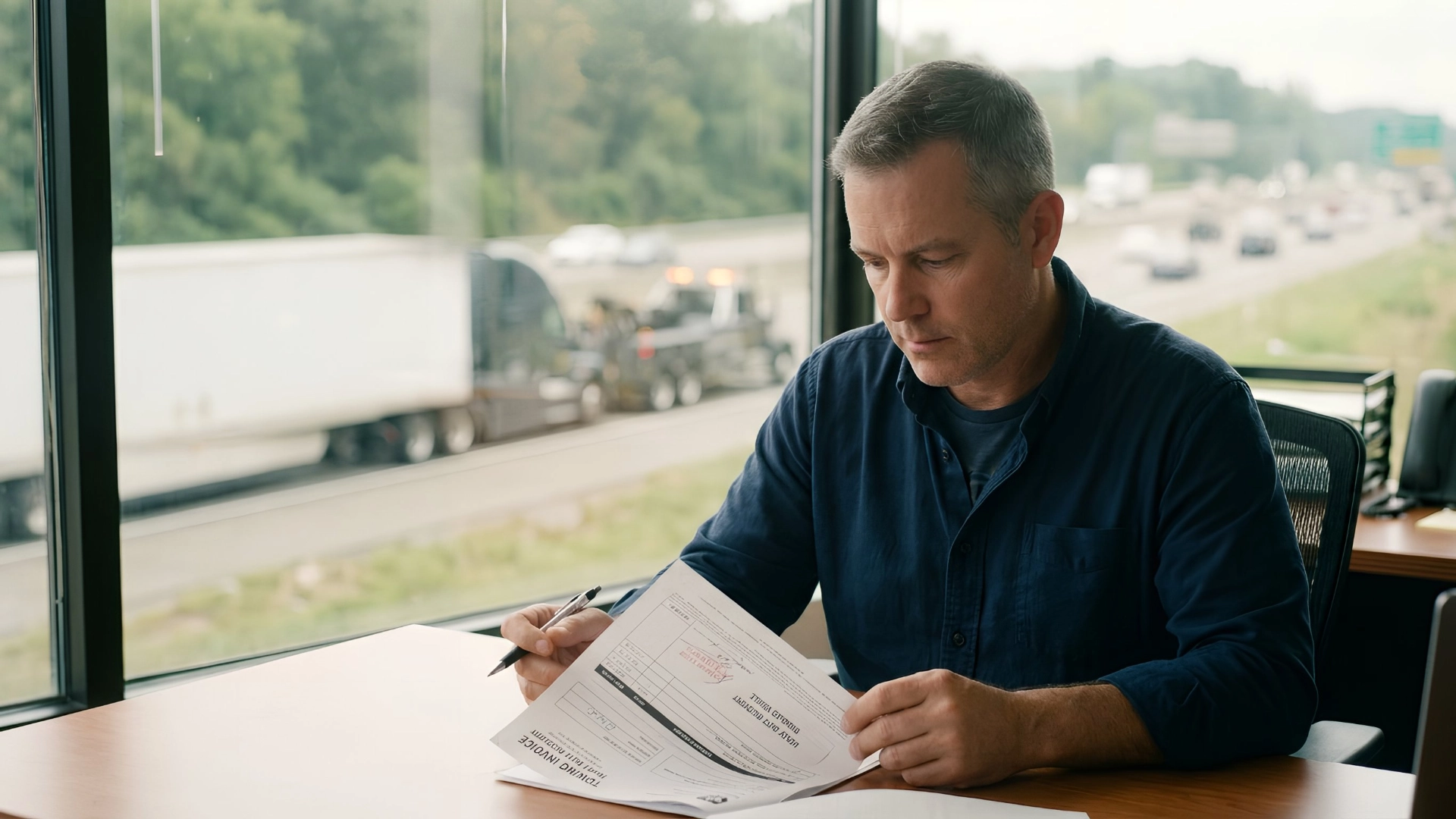


A tow truck arriving at a breakdown scene is a welcome sight for a stranded driver. What shows up in the mail two weeks later is often a different story. The American Transportation Research Institute's 2023 study on predatory towing, conducted with 350 motor carriers and analysis of 490 real towing invoices, found that 82.7% of carriers had been billed at excessive rates and 81.8% had been charged for unwarranted additional services. Nearly 30% of all crash-related towing invoices contained excessive rates or unwarranted charges.
This is not an isolated problem concentrated in a few bad markets. ATRI found no regional pattern: carriers in every part of the country reported predatory billing. California had the highest total number of reported incidents, and Indiana had the worst rate relative to miles driven, but the top ten states span every region of the country. The problem is structural, not geographic, and it is expensive. ATRI's analysis of actual invoices put the average tow-and-recovery cost at $11,681 per event. When predatory billing enters the picture, that figure can exceed $18,000 on a single incident. Individual cases have run far higher: Florida Trucking Association documented invoices reaching $200,000, and a Memphis operator billed one carrier $12,950 and another $4,550 within days of each other for similar events.
Fleet managers who have been through one of these situations know the pattern. Those who have not are likely to encounter it. Understanding how predatory towing works, what protections exist, and what to do before, during, and after a tow is the practical preparation that limits exposure.
ATRI's formal definition covers the essentials: predatory towing is any incident in which a towing and recovery company egregiously overcharges, illegally seizes assets, damages assets through improper equipment, or withholds the release of a truck, trailer, or cargo. In practice, the mechanism concentrates most heavily in nonconsensual tows, where the fleet had no opportunity to select the provider.
A nonconsensual tow happens in one of two ways. The first is a police-initiated tow after a crash or when a disabled truck is blocking traffic. Law enforcement calls from a rotation list of approved providers, and the fleet has no input into which company responds. The second is an impound tow from private or public property where the vehicle is parked improperly. In both cases, the towing company knows the fleet cannot shop for alternatives, cannot compare rates, and in most circumstances cannot refuse service while the truck sits on a highway shoulder or a customer's lot.
ATRI's research identified eight common forms of predatory billing that carriers encounter. Excessive hourly or per-pound rates were the most reported, with the median rate for a basic heavy-duty tow running $291 per hour. ATRI determined that rates above $436.50 per hour are excessive by the study's benchmarks. For crash-site recoveries, the median was $582 per hour, with rates above $873 considered excessive. A carrier in the ATRI research reported being billed approximately $1,000 per hour from arrival to drop.
Unwarranted additional services came in as the second most common form of abuse, appearing in 81.8% of carrier reports. This category includes billing for equipment never used, charging for labor hours beyond what the job required, and adding supplementary tools to inflate the line-item count. A quarter of the invoices ATRI analyzed were not itemized at all, which provides cover for exactly this kind of inflation. If the invoice does not break down what was charged and why, there is no basis for comparison or dispute.
Excessive daily storage rates affected 77.7% of respondents. The median storage rate in the invoices ATRI reviewed was $120 per day. Storage charges accumulate rapidly during disputes, which creates financial pressure to pay even a questionable invoice rather than let the bill grow while the truck sits in a yard. Vehicle release delays, which affected 71.7% of carriers, reinforce this dynamic: the tow company can simply refuse access to the truck or cargo until the invoice is settled, regardless of whether the charges are legitimate.
The remaining practices ATRI identified include cargo held as a bargaining tool until the invoice is paid, equipment damage from improper towing methods, vehicle seizure without cause when a tow truck arrives uninvited, and misreporting a nonconsensual tow as consensual to escape regulations that would otherwise apply. That last practice is particularly important: some towing operators pressure drivers to sign documents at the scene that reclassify the tow as consensual, removing the legal protections that apply to nonconsensual events. The American Trucking Associations' position on this is direct: no such signature should be given, and drivers should be trained in advance to refuse it.
The best protection against a predatory billing dispute is documentation collected before the tow truck leaves. ATRI's research, including a Q&A with transportation attorneys Rob Moseley and Martin Cain of Moseley Marcinak Law Group, and Adam Brand and Shahan Kapitanyan of Brand and Tapply LLC, is specific about what information matters.
The driver should record the time the tow truck arrives and the time it leaves. They should document every piece of equipment used, the number of people working the job, and whether any outside resources participated, such as fire department personnel or utility workers. This information is what becomes the carrier's evidence if the invoice is disputed. A tow company billing for four hours of labor when the job lasted two hours can only be effectively challenged if someone timed the job.
Video and photo documentation of the scene should happen before the tow begins. This means capturing the truck's position, the condition of the truck and trailer, and the towing equipment being used. Photos taken after the fact do not establish condition at the time of the event. If equipment damage appears later that appears inconsistent with the failure that caused the breakdown, documented pre-tow condition provides the baseline for a damage claim.
Critically, the attorneys' guidance is that drivers should not sign any documents presented by the towing operator at the scene. Consent forms, assignment of rights, and rate agreements have no signature requirement, and signing them may reclassify the tow in ways that remove regulatory protections or transfer dispute rights. Drivers should be trained on this before it becomes a live situation, not at 2 AM on the side of the highway.
One of the core structural problems that enables predatory towing is the absence of federal authority over the towing industry. Neither the FMCSA nor the FTC has direct regulatory power over towing and recovery companies, which are governed by a patchwork of state, county, and municipal regulations. This is not a procedural detail. It has direct consequences for how a fleet can respond to an abusive invoice.
In many states, law enforcement agencies that call a tow from their rotation list are reluctant to get involved in billing disputes, and in some jurisdictions they are explicitly prohibited from doing so. The entity that selected the towing company has no accountability for what the company charges. The fleet's recourse runs through the courts and through state complaint mechanisms, not through the agency that initiated the tow.
The regulatory landscape has been changing. Following ATRI's 2023 report, five states enacted new predatory towing legislation in 2024. Florida's House Bill 179, signed by Governor DeSantis in March 2024, introduced 17 changes including requirements for towing operators to provide a rate sheet before attaching any vehicle, and a provision that any fee beyond the listed rate is considered unreasonable by statute. Mississippi's legislation, signed in April 2024, banned per-pound billing for nonconsensual tows and established a Commercial Vehicle Towing Advisory Committee to set maximum rates for nonconsensual events. Tennessee, Colorado, and Virginia all passed separate reforms targeting solicitation at breakdown scenes, rate transparency, and complaint mechanisms.
Indiana passed additional legislation in 2025, requiring law enforcement rotation agreements to include specific rates and prohibiting rotation towing companies from charging fees not listed in those agreements.
This wave of reform signals that the legislative environment is moving, but the coverage remains uneven. Most states still have minimal regulation of nonconsensual towing rates for commercial vehicles. A fleet operating across 48 states cannot assume the protections that exist in Florida or Mississippi apply in the states where its trucks run most of their miles.
Receiving an invoice that appears abusive does not mean paying it is the only option, but the response needs to be deliberate. The attorneys in ATRI's research report outlined a sequence that fleet managers should follow.
The first call is to the fleet's insurer. In many cases, the insurance carrier has both the negotiating leverage and the legal resources to dispute an invoice on the fleet's behalf. Towing operators who face pushback from an insurer with an attorney on retainer behave differently than those dealing with a fleet manager calling from a cell phone. The insurer should be notified immediately, before any payment is made.
If the invoice is clearly excessive and cannot be negotiated down through the insurer, legal options include a temporary injunction to retrieve the truck without paying the full invoice, a replevin action allowing the fleet to post a bond and recover the vehicle while the dispute continues, and claims for unjust enrichment, fraud, and unfair trade practices. In states where the relevant statutes apply, the towing company's conduct may also be actionable under state consumer protection law.
A Freedom of Information Act request to the relevant Highway Patrol or State Police agency can produce records of the towing company's membership on the rotation list and any complaints previously filed against them. This information matters for litigation and for regulatory complaints, and it is available to any carrier that knows to request it.
Filing formal complaints with the state Highway Patrol, state Department of Transportation, and the state Attorney General creates a documented record that supports regulatory action and strengthens any legal claim. ATRI maintains a publicly available state-by-state compendium of towing regulations that identifies which agencies have complaint authority in each state.
The key point attorneys in ATRI's research emphasize is that the invoice should not be paid in full simply because the truck is being held. Paying under protest while pursuing legal remedies preserves the fleet's legal position better than either refusing to pay or paying without objection.
The most effective protection against predatory towing is preparation that happens before any breakdown occurs. The structural advantage the towing company holds in a nonconsensual tow situation is that the fleet did not anticipate it, has no pre-established provider relationship, and has no information about rates in that market. Pre-positioning reduces all three disadvantages.
ATRI's recommendation, endorsed by the ATA, is that fleets contact their state or regional trucking association to identify preferred towing operators along their most-traveled routes. Some states allow law enforcement, on request, to call a specific provider rather than selecting from the rotation list. Building a list of vetted towing contacts by corridor and having that list accessible to dispatchers at any hour means that when a driver calls in a breakdown, there is an immediate option to request a known provider rather than accepting whoever shows up.
Understanding the towing laws in the states where a fleet runs regularly is a parallel step that most fleets have not taken. Rate structures, what constitutes a legal nonconsensual tow, and what complaint mechanisms exist differ materially by state. A fleet whose trucks frequently run through Indiana, New Jersey, and Mississippi is operating in three states with significantly different regulatory frameworks, and the driver at the scene will not know which rules apply without preparation.
For fleets that use a coordinated truck roadside assistance program with pre-vetted vendors and pre-negotiated pricing, the predatory towing exposure is structurally lower because the vendor selection happens through a vetted network rather than a police rotation or an ad-hoc emergency search. When a breakdown occurs, the fleet is not relying on whoever responds first. That preparation does not eliminate the possibility of a nonconsensual tow in a crash scenario, but it covers the far more common breakdown situation where the fleet retains some vendor selection control.
The companion article on commercial truck roadside assistance versus fleet coordination covers this structural distinction in detail and explains why the vendor selection model affects what a fleet pays during a breakdown event.
Connecting breakdown response to a broader preventive maintenance program that reduces breakdown frequency is the other half of exposure management. A truck that breaks down less often faces fewer tow events, which means fewer opportunities for the situation that predatory operators depend on. The semi truck preventive maintenance schedule on this site covers the interval structure that reduces roadside events.
If your fleet has been through a predatory towing situation or wants to build a breakdown response structure that limits vendor exposure, reach out to our team. The nationwide truck repair network includes vetted towing and recovery resources through partner shops across 48 states, with pre-established pricing that does not get negotiated for the first time at a highway shoulder.
This article draws on the following sources:



.webp)