
We are here for you
Thank you! Your submission has been received!
Oops! Something went wrong while submitting the form.


A trailer brake violation at a DOT inspection means the unit is parked until repaired. A worn kingpin or deteriorated fifth wheel jaw can mean something worse: a trailer that separates from the tractor while moving. The coupling system is the single point of connection between 70,000 pounds of loaded trailer and the tractor pulling it, and the wear that leads to failure does not announce itself through a dashboard warning light or a visible symptom a driver can spot in 30 seconds at a fuel stop.
This article covers how fifth wheel and kingpin wear develops, what the failure mechanisms look like in practice, what the inspection standards require, and how coupling hardware interacts with the rest of the trailer maintenance program. It does not cover brakes, lighting, or tires, which are addressed separately in the companion article on trailer DOT inspection violations. Coupling hardware deserves its own treatment because the failure consequences are categorically different and the maintenance practices required to catch wear are less familiar to most fleet managers than brake or lighting checks.
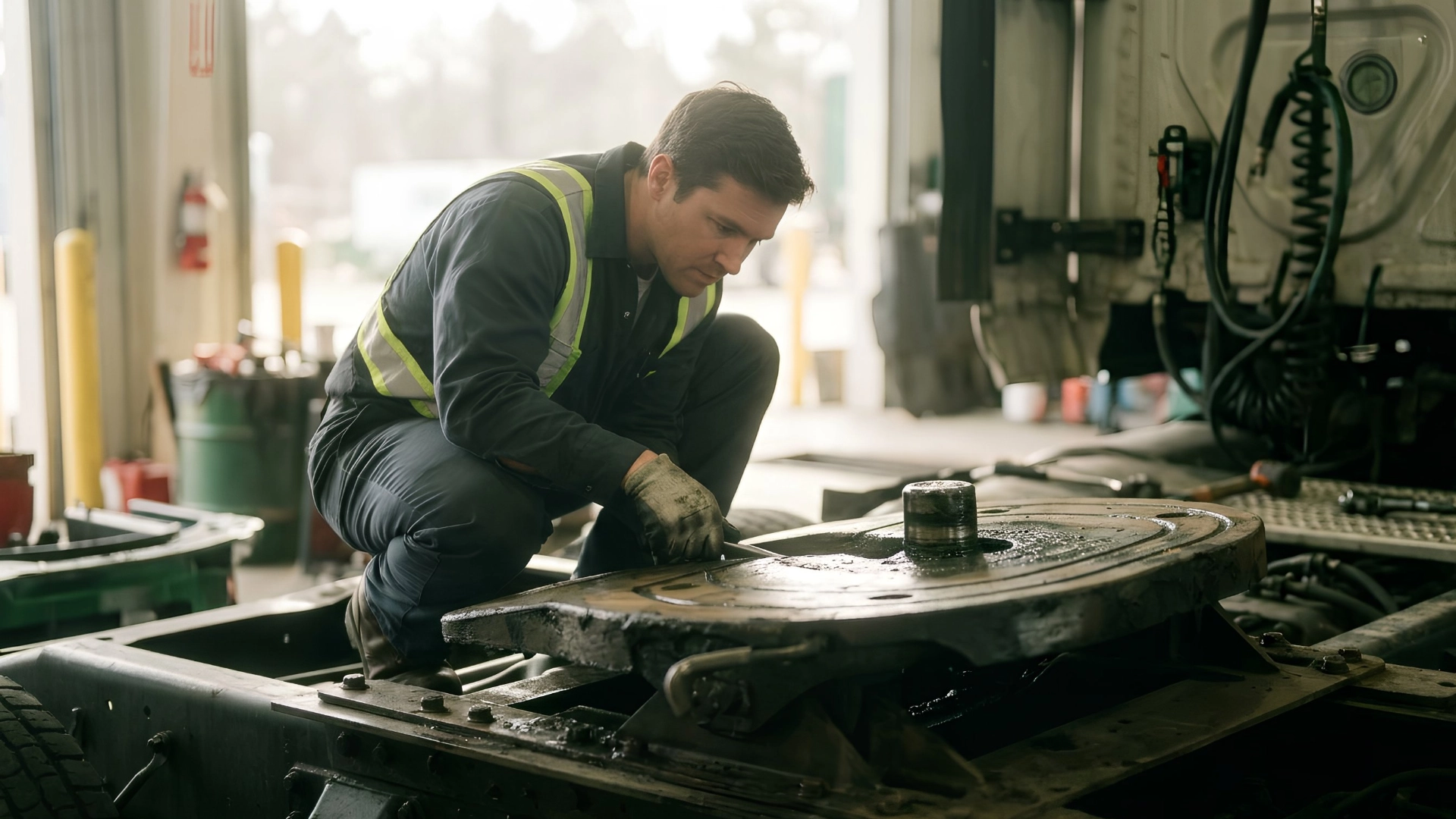
Understanding how these components wear requires understanding the forces they manage during normal operation. The fifth wheel plate is the cast steel surface mounted on the rear of the tractor frame. It supports the full vertical load of the trailer's front end, which on a loaded 53-foot dry van can exceed 25,000 pounds on the kingpin alone. The kingpin is a precision-machined steel post extending down from the trailer's upper coupler plate. When the tractor backs under the trailer, the kingpin travels through the fifth wheel throat and into the locking jaws, which close around the kingpin's narrow shank and lock in place to complete the coupling.
During travel, this connection is dynamic. Every turn causes the trailer to pivot on the fifth wheel plate, and that pivot involves metal-to-metal sliding contact between the upper coupler plate and the fifth wheel surface. Acceleration and braking transfer longitudinal forces through the kingpin into the fifth wheel jaws. Every grade change and road irregularity transmits vertical loads through the coupling. Over millions of miles, this constant motion under load produces wear in the kingpin shank, the fifth wheel jaws, the locking mechanism, and the upper coupler plate itself. None of that wear is avoidable. The question is whether the fleet is tracking it against the tolerance limits at which the hardware needs to be replaced or repaired.
SAF-Holland, a primary manufacturer of kingpins and fifth wheel systems, publishes inspection and replacement criteria based on SAE J2228, the commercial trailer industry standard for kingpin wear limits. The standard is specific: a kingpin that has worn 1/8 inch or more on either the 2-inch or the 2-7/8-inch diameter in any direction must be replaced. These are the two measurement points on the kingpin shank where the locking jaws make contact, and wear at these points directly affects how securely the jaws can engage and hold the kingpin under load.
SAF-Holland recommends that kingpin inspections be conducted every three months or 30,000 miles. The inspection is not a visual pass. It requires a kingpin gauge, a specific tool that physically checks whether the wear at the contact points exceeds the SAE tolerance. A worn kingpin can look intact in a visual inspection; the surface will appear smooth and undamaged precisely because the wear is uniform. The gauge is what reveals whether the critical dimensions are still within spec.
Beyond diameter wear, the inspection protocol covers three other conditions. The kingpin must be checked for bending using a square: any deviation greater than one degree from true vertical indicates a bent kingpin, typically caused by coupling at speed or a dock impact. A bent kingpin accelerates jaw wear in the fifth wheel and can prevent proper locking engagement. The kingpin length must also be verified, because a kingpin that is too long or too short relative to the upper coupler plate thickness causes misalignment in the jaw engagement and creates premature wear in the locking mechanism. Finally, the upper coupler plate itself must be checked for flatness using a 48-inch straightedge, since warping or waviness in the plate surface causes uneven loading of the fifth wheel and shortens lock life.
According to Kingpin Specialists, a fleet in food service or freight delivery with intensive drop-and-hook operations and no structured kingpin maintenance program will average a 25 to 30 percent defect rate across its trailer fleet. That means up to 30 out of every 100 trailers are operating with kingpin wear that exceeds specifications and is actively damaging every fifth wheel it contacts. The problem compounds: a worn kingpin accelerates jaw wear in every tractor it couples with, and a damaged fifth wheel jaw in turn accelerates kingpin wear in every trailer it hauls. Kingpin Specialists estimates that a structural trailer repair resulting from ignored kingpin wear costs approximately $10,000 per unit, and that accumulated fifth wheel damage across a 100-trailer fleet with no maintenance plan can reach tens of thousands of dollars in additional repairs over a three-year period.
The fifth wheel itself wears at three distinct points, each requiring different inspection approaches and different replacement triggers.
The top plate is the primary contact surface between the tractor and trailer. During every turn, the upper coupler plate slides across this surface under the weight of the trailer. Proper lubrication is what keeps this metal-to-metal contact from accelerating into abrasive wear. Manufacturers including SAF-Holland, Fontaine, and JOST specify that the fifth wheel top plate should be lubricated at every PM interval. Overdrive's analysis of manufacturer recommendations puts the standard interval at weekly or every 3,000 miles for high-activity drop-and-hook operations, with jaw mechanism lubrication at every 30,000 to 60,000 miles. Graco's technical guidance is more cautious, noting that intervals alone are insufficient: poor greasing technique, including over-application that builds a contaminated grinding paste or under-application that allows metal contact, can cause premature wear even at correct intervals.
The jaw area is where the actual locking function lives. The jaw, sometimes called the lock or the jaw assembly, grips the kingpin shank when coupling is complete. Wear in the jaw surfaces creates lateral play between the kingpin and the locking mechanism. This play, when it becomes significant, produces the clunking sound on acceleration and braking that Troy Widtfeldt of Badger Product Group describes as one of the clearest early indicators of coupling wear. A driver who reports this sound is giving the maintenance team a specific, actionable signal that the jaw area needs inspection. The sound is not road noise and it is not normal behavior. It is metal speaking.
The bracket liners, which are the wear surfaces that cushion the fifth wheel mounting bracket against the tractor frame, have their own replacement criteria. Most manufacturers specify replacing bracket liners every 300,000 miles in standard-duty operation and every 180,000 miles in moderate or severe duty. A liner worn below 0.125 inches at the top must be replaced regardless of mileage. Liners that are cracked, broken, or excessively worn allow the fifth wheel to shift under load, which changes the coupling geometry and creates unpredictable stress on the jaw and kingpin system.
The pull test is the coupling verification step that drivers perform after hooking to a trailer. The driver moves the tractor forward against the locked trailer to confirm the coupling held. It is the correct first check, but it is frequently misunderstood as sufficient. As maintenance specialist Brown, quoted in Overdrive's fifth wheel maintenance guide, notes: "A lot of guys don't get much beyond the tug test. But that won't tell you much, not even whether the lock is properly engaged."
The pull test confirms that the kingpin did not separate under the tension of a short, controlled pull. It does not confirm that the jaw is fully closed, that the locking mechanism is correctly engaged, or that the coupling hardware is within wear tolerances. A worn jaw can pass the pull test and still allow progressive play under the dynamic loads of highway travel. The only way to verify that the jaw is fully closed is to physically check the locking indicator or verify by sight that the release handle is fully retracted into the casting.
Improper coupling technique also generates a specific pattern of damage that technicians can identify. When a driver has failed to couple correctly and the kingpin has ridden over the front skirt of the fifth wheel rather than seating in the throat, the telltale marks will be visible on the top of the fifth wheel plate, typically as scoring or impact marks near the front edge. Tony Ryan of SAF-Holland, quoted in Fleet Maintenance's coupling care feature, identifies this as one of the most frequent causes of coupling-related damage in fleet service, and notes that it is often the result of the tractor being positioned too high relative to the trailer's upper coupler plate height during coupling.
The coupling system is not limited to the mechanical connection between the fifth wheel and kingpin. Every time a trailer is hooked up, the driver also connects the air lines through the gladhand couplings and plugs in the seven-way electrical connector. These connections cycle through the same pattern of engagement, vibration, load, temperature change, and disengagement as the mechanical coupling, and they wear in ways that affect both braking and lighting systems on the trailer.
Gladhand seals are rubber gaskets that create an airtight seal between the tractor and trailer air lines when the gladhands are coupled. SAF-Holland and Great Dane both specify checking gladhand grommets regularly and replacing them when they become hard. A hardened gladhand seal does not compress fully under coupling pressure, which allows air to leak from the service or emergency brake circuits. Air leaking from the emergency line will, over time, trigger the trailer's spring brakes as pressure drops below threshold. Air leaking from the service line reduces braking force in ways that may not be detectable during a driver's pre-trip check but that will show up as a brake performance issue under hard application.
The seven-way electrical connector and its receptacle on the trailer front face are subject to corrosion from the same moisture, road salt, and thermal cycling that affects the coupling hardware. Great Dane recommends applying dielectric grease to the electrical plug to prevent corrosion buildup at the contacts. Corroded contacts cause intermittent electrical faults on the trailer, which typically affect lights and ABS function in patterns that are difficult to diagnose without cleaning and inspecting the connector socket first. A plug that has accumulated corrosion for several seasons can fail circuits selectively and intermittently, meaning the problem may not be visible during the static inspection performed at PM.
The coupling system sits at the intersection of the tractor maintenance program and the trailer maintenance program, but in most fleets it falls cleanly into neither. The fifth wheel is a tractor component. The kingpin and upper coupler plate are trailer components. The gladhands and air lines straddle both. This jurisdictional ambiguity is part of why coupling hardware inspection often gets less systematic attention than either the tractor powertrain or the trailer brake and lighting systems.
A structured preventive maintenance program that includes coupling hardware needs to assign clear ownership: which inspection points are checked during tractor PM, which are checked during trailer PM, and which require the tractor and trailer to be coupled together to evaluate. The kingpin gauge check and upper coupler plate flatness test are trailer PM items. The fifth wheel jaw inspection, bracket liner measurement, and top plate lubrication are tractor PM items. The gladhand seal check and seven-way connector inspection require both components to be physically present at the same time, which is why they are most effectively included in coupling checkout procedures rather than separated into tractor-only or trailer-only checklists.
Fleets that want consistent coupling hardware inspection across a large equipment pool, particularly those running trailers through multiple states and multiple partner shops, benefit from having those standards built into the network rather than renegotiated at each service location. Truck repairs and diagnostics at shops that are vetted for commercial fleet capability and operating to consistent standards produce records that actually reflect the condition of the coupling hardware, which is what a DOT inspector, a liability attorney, or a safety director needs to see.
For fleets looking to build trailer coupling maintenance into a structured program through a vetted nationwide truck repair network, reach out to our team to discuss how that coverage applies to both tractors and trailers across your operating footprint.
This article draws on inspection and maintenance guidance from SAF-Holland's published kingpin inspection procedures based on SAE J2228, sourced via Heavy Duty Trucking and Automotive Fleet; fifth wheel wear and lubrication reporting from Fleet Maintenance including fifth wheel lubrication analysis, coupling care coverage, and tractor-trailer connections reporting; fleet failure rate and structural repair cost data from Kingpin Specialists; and fifth wheel maintenance interval data from Overdrive and Graco.