

We are here for you
Thank you! Your submission has been received!
Oops! Something went wrong while submitting the form.
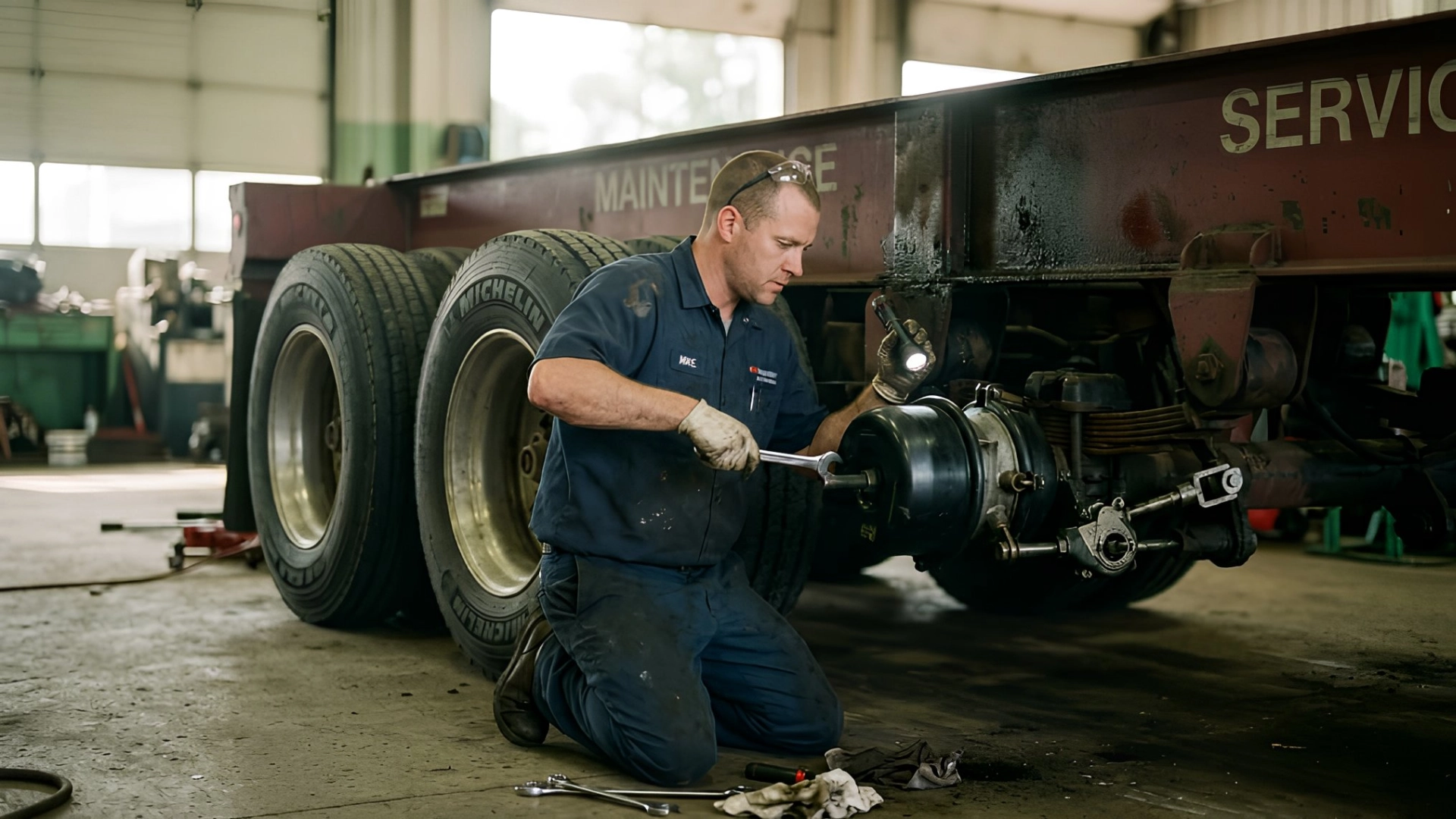


Trailers are inspected separately from tractors at roadside stops. Every violation found on the trailer goes on the carrier's CSA score, the same as a tractor violation would. And yet, in most fleets, trailer maintenance gets less structured attention than tractor maintenance. The assumption tends to be that trailers are simpler equipment, that there is less to go wrong, and that the driver's pre-trip will catch anything serious. None of that holds up under an inspection.
Data from the CVSA's 2024 International Roadcheck, which covered more than 47,000 inspections across North America, shows a 23% vehicle out-of-service rate. More than 9,300 commercial vehicle combinations were placed out of service over three days. The top categories driving those numbers were brakes, tires, and lights, all of which are as much a trailer problem as a tractor problem, and in many fleets are more likely to be in poor condition on the trailer than on the power unit.
This article covers the four areas where trailers fail DOT roadside inspections most often, why they fail, and what targeted preventive maintenance catches before an inspector does.
Before getting into the specific systems, the business consequence is worth stating plainly. When a driver gets placed out of service for a trailer violation, it is not a driver problem. The points land on the fleet's Vehicle Maintenance BASIC under the CSA scoring system. The driver keeps moving once the violation is corrected; the fleet carries the score impact for two years, weighted more heavily for the first six months.
A single brake out-of-adjustment violation carries a severity weight of four points in the CSA system. Multiply that by the time weight of three applied to violations in the most recent six months and one inspection finding produces twelve CSA points against the carrier. Accumulate enough of those and the fleet's percentile rank climbs into ranges that attract more frequent inspections, harder scrutiny from insurance underwriters, and reduced appetite from brokers who screen carriers by CSA performance before tendering loads.
The maintenance consequence of a trailer out-of-service order is also different from a tractor event. The tractor can sometimes continue with a different trailer. The load may sit. Scheduling downstream of that trailer is disrupted. The repair has to happen before the unit moves, which means whatever shop is nearby handles it at whatever rate they charge, with no pre-negotiated pricing and no guarantee they have the right parts. That is a more expensive problem than the same failure caught during a scheduled PM at a vetted shop.
Brake violations consistently generate more out-of-service orders than any other trailer system. During the 2024 International Roadcheck alone, inspectors cited more than 3,300 brake-related out-of-service violations across the inspected vehicle combinations. The threshold that triggers an immediate out-of-service order is straightforward under the regulations: if 20% or more of the service brakes on the trailer are found to be defective, the unit is parked until repaired.
The most commonly cited brake violation on trailers is brakes out of adjustment. This is worth understanding in detail because it catches many fleets off guard. A trailer can have functional, relatively new brake hardware and still generate an out-of-adjustment citation at inspection. The brake stroke, which is the travel of the pushrod when the brakes are applied, must fall within a specific range depending on the chamber size. A slack adjuster that was not set correctly, that has developed wear, or that has not been checked since the last tire swap is all it takes.
The problem is compounded by the fact that brake stroke is not visible during a standard pre-trip inspection. A driver walking the trailer perimeter cannot see whether the stroke is within spec without measuring it, and most pre-trips do not include that check. Penske's 2024 maintenance data confirms that brake out-of-adjustment remained one of the most frequent roadside violations that year, specifically noting that automatic slack adjusters do not eliminate the problem because they can fail to adjust correctly without producing an obvious external symptom.
What catches this during a PM is a qualified technician with a brake stroke gauge checking each wheel end at each service interval, not just inspecting the visible hardware. Air lines and chambers also need physical inspection at every PM. Gladhand seals, which wear faster than most fleets track, are a common source of air loss that shows up at a roadside inspection before it becomes severe enough to affect braking feel in the cab.
According to Penske's analysis of 2023 roadside inspection data, the single most common vehicle violation across all categories was an inoperable required lamp. Inoperative turn signals and missing or defective lighting devices were also in the top ten. Three of the ten most cited violations that year were lighting issues, all of them preventable with consistent inspection and routine bulb replacement.
Trailers are the source of a disproportionate share of lighting violations for one practical reason: the electrical connection between the tractor and trailer is a moving junction that cycles through vibration, moisture, dirt, and repeated connect-disconnect cycles throughout its service life. Corrosion builds at the seven-pin connector and at the plug receptacle on the trailer. Individual circuits fail selectively, meaning a brake light may work on one side and not the other without being obvious from the cab. Clearance lights mounted on the trailer roof collect moisture and crack. Marker lights on the side of older trailers corrode internally.
The failure pattern here is not typically sudden. Lights degrade gradually. A lamp that is intermittently functional during normal operation will often fail to illuminate under a static inspection when the inspector is watching. Drivers who note lighting issues on a DVIR that then do not get corrected before the next dispatch are carrying a violation waiting to be cited.
The maintenance fix is not complicated but does require consistency. At every PM service, a full lighting check of the trailer should include walking the perimeter with the truck running and all circuits active, checking brake lights with a second person applying the pedal, testing the ABS warning light function on trailers manufactured after 1998, and inspecting the seven-way connector and socket for corrosion or damage. LED lighting upgrades are worth considering for fleets running high-mileage trailers, since LED systems have significantly longer service lives and are more resistant to vibration failure than incandescent alternatives.
The 2024 Roadcheck cited more than 2,800 tire-related out-of-service violations. The regulatory standards for trailer tires are not complicated. Minimum tread depth is 2/32 of an inch on all trailer axle positions. Any tire that is flat or has an audible air leak is an immediate out-of-service condition. Sidewall damage that exposes the body ply, visible bulges, or any condition that compromises the structural integrity of the tire will result in a citation.
Where fleets commonly get caught is not with obviously worn tires but with tires that are marginal. A tire at 3/32 tread depth passes the federal minimum but has very little buffer before it fails the next inspection or blows on the highway. Trailers that run with different tractors and are not assigned to a specific route can move through the fleet without anyone taking clear ownership of the tire condition on that unit. By the time the tire gets flagged at a PM, it may already be at the threshold that an inspector would cite.
Inflation pressure is the other persistent issue. Trailer tires run underinflated more often than fleet managers realize. The tractor air supply maintains cab tire pressure feedback, but there is no equivalent alert for trailer tires in most older configurations. A tire at less than 50% of its maximum inflation pressure is an out-of-service condition. One at 70% is still creating heat, wear, and fuel inefficiency without triggering any dashboard warning. Checking trailer tire pressure with a calibrated gauge at every PM interval, not just a visual check during pre-trip, is what catches this before it becomes a violation or a blowout.
This one is not a mechanical failure. It is a paperwork failure, and it is the second most common vehicle maintenance violation in the country with more than 133,000 citations issued annually. Under 49 CFR Part 396.17, every commercial trailer must have a valid annual periodic inspection. The documentation must be on the trailer and must be available for inspection. A valid CVSA decal or an inspection report identifying the vehicle, the date, and the certifying inspector meets the requirement.
An expired sticker is one of the easiest violations for a roadside officer to spot because it requires no diagnostic work. The inspector walks around the trailer, looks at the sticker, and if it is expired or missing, the citation is written. For a fleet running 20 or 30 trailers, one unit with an expired annual inspection that gets dispatched without anyone checking the documentation generates a four-point CSA hit that stays on the record for two years.
The fix is administrative, but it needs to be embedded in the fleet's maintenance scheduling system rather than tracked manually. Every trailer in the fleet needs an annual inspection in the 12 months before it is dispatched, and the documentation needs to stay with the unit. If the annual falls during a slow period, it should be completed then, not deferred. The inspection itself also needs to be performed by a qualified inspector under the FMCSA's definition, not just any shop employee who walks around the trailer.
The systems covered above, brakes, lights, tires, and annual documentation, account for the overwhelming majority of trailer out-of-service orders at roadside inspections. None of them require exotic maintenance procedures. They require consistency: correct intervals, qualified technicians, and a system that does not let a trailer get dispatched with overdue service or expired documentation.
Trailer maintenance should be part of the same structured PM program that governs tractor service. If your fleet's PM schedule covers tractor intervals in detail but handles trailers informally, that gap will eventually show up as a CSA violation or a roadside event. The semi truck preventive maintenance schedule article on this site explicitly notes that trailers require their own structured program. This article is what that program targets.
When trailer violations do produce a roadside breakdown, having a support structure that can locate a qualified shop quickly matters as much as the maintenance program that was supposed to prevent the event. Truck roadside assistance that covers the trailer, not just the tractor, is the other half of that equation.
Fleets that want to reduce their CSA exposure and keep trailers out of service orders off their record can also reach out to our team to discuss how a structured preventive maintenance program through a vetted nationwide truck repair network applies to trailer equipment, not just tractors.
This article draws on CVSA 2024 International Roadcheck results published at cvsa.org, Penske Truck Leasing's analysis of 2023 top roadside violations and 2024 CSA improvement data, CSA severity weight data published by Heavy Vehicle Inspection and MySafetyManager, Acuity Insurance's brake compliance analysis, and FMCSA regulations under 49 CFR Part 396.