

We are here for you
Thank you! Your submission has been received!
Oops! Something went wrong while submitting the form.
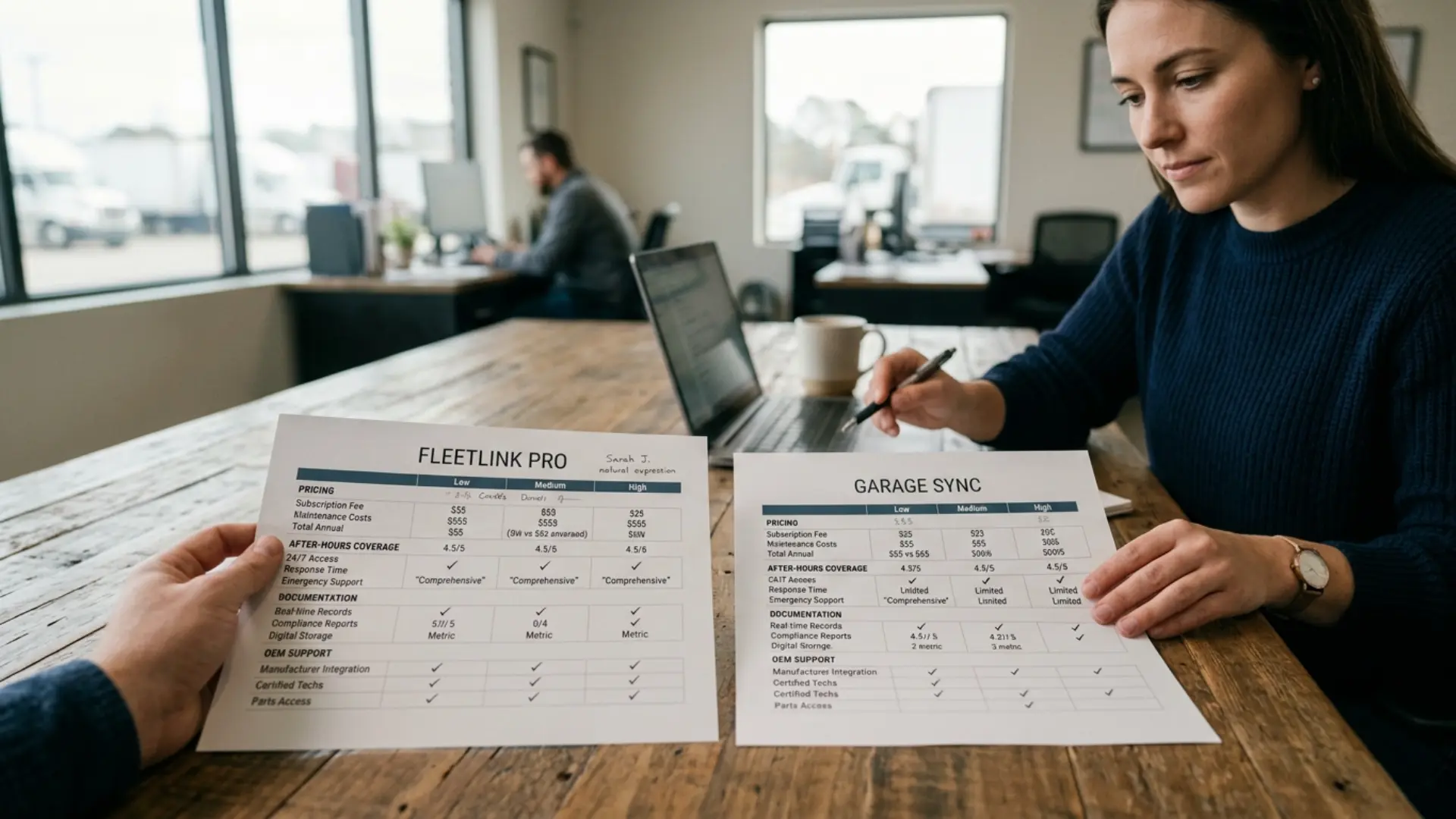

Two coordination programs on a fleet manager's shortlist can both claim nationwide coverage, 24/7 support, and vetted shop networks, and still produce entirely different outcomes once a truck actually breaks down. The marketing language converges because every provider knows what a fleet manager wants to hear. The operational reality behind that language does not converge at all, and the only way to see the difference is to compare specific criteria against each other rather than accepting each program's description of itself at face value.
A truck preventive maintenance coordination program is a service relationship, not a product with a spec sheet. That makes it harder to compare than software, where feature lists can be checked line by line. The six criteria below give a fleet manager a way to test two or more programs against each other on the dimensions that actually predict performance, rather than comparing brochures.
Every coordination program will quote a price. Few will show the mechanism behind it before a contract is signed. The comparison that matters is not which program's quoted number is lower. It is whether each program can explain, in specific terms, how its pricing model works and what data supports the savings it claims to deliver.
OxMaint's fleet vendor management research documents a case where a 500-vehicle fleet spending $4.2 million annually across 47 different vendors had no visibility into pricing variation at all, until an audit found that an identical brake service cost $340 at one vendor and $420 at another, with OEM parts sourcing showing 18 to 26 percent price variation for identical components across vendors. That fleet had no comparison framework in place internally. The same blind spot applies when a fleet manager compares coordination programs externally: without asking each program to show its actual fee structure and how pre-negotiated rates are calculated, the fleet cannot know whether one program's quoted savings are real or simply asserted.
The specific question to ask each program on the shortlist: can you show me your fee schedule in writing, and can you explain what data supports the percentage savings you claim your network pricing delivers versus standard market rates? A program that answers with specifics is behaving differently from one that answers with a general assurance that its network saves money.
Every program on a shortlist will state that it provides 24/7 coverage. The comparison that separates real capability from a marketing claim is whether that coverage holds up on the specific corridors a fleet actually runs, not on a national average.
The test that reveals the difference between programs is a direct call to each provider's after-hours line, outside business hours, on a specific corridor the fleet uses regularly. A program with genuine after-hours capability answers with a live person who can confirm vendor availability on that corridor within minutes. A program whose after-hours coverage is thinner than its marketing suggests either does not answer promptly or cannot confirm a vendor on that specific route without extended hold time. Torque by Ryder's provider evaluation guidance frames this directly: how a provider handles after-hours breakdowns is one of the clearest signals of whether the relationship is built around the fleet's actual operating pattern or a generic service description.
For fleets running secondary or rural corridors rather than only major freight hubs, this test matters even more, because coverage density on Interstate 40 through Memphis does not tell a fleet manager anything about coverage on a rural highway in eastern Kansas. Comparing two programs on this criterion means testing both against the fleet's actual lanes, not accepting either program's stated coverage map without verification.
A program's documentation quality is one of the easiest criteria to compare directly, because it can be requested in writing before any contract is signed. Ask each program on the shortlist for a sample work order from a recent commercial repair event. The comparison is immediate: does the sample include vehicle identification, odometer reading, specific parts replaced with part numbers, technician identification, and repair certification, or does it read as a generic invoice listing labor hours and a total.
The FMCSA fleet maintenance records article on this site covers exactly what a compliant work order must contain under 49 CFR Part 396 and why the difference between a billing record and a maintenance record matters at audit time. Comparing two programs' sample documentation against that standard is a concrete test that does not depend on trusting either program's description of its own record-keeping practices.
Repair order visibility while the work is in progress is a related but separate dimension worth comparing. Fleetio's provider evaluation framework notes that the ability to track maintenance progress in real time, rather than waiting for a completed invoice, prevents the miscommunication and documentation gaps that accumulate when a fleet has no visibility into a repair until it is already finished and billed.
A program that covers "all makes" in its marketing may have deep, verified capability on one or two OEMs and thin, unverified coverage on the rest. For a fleet running a single make, this criterion is simpler to check. For a mixed fleet running Freightliner, Peterbilt, and International simultaneously, comparing two programs on this dimension requires asking each one to confirm, by name, which OEM diagnostic platforms their network shops carry for every make the fleet operates.
The comparison test: give each program on the shortlist a specific part number or fault code scenario for each of the fleet's OEMs, and ask them to confirm real-time parts availability and diagnostic capability for that scenario. A program with genuinely broad OEM coverage answers all of them with specifics. A program whose coverage claim is broader than its actual network capability hesitates or cannot confirm one or more of the makes without an extended follow-up.
If your fleet is running a mixed OEM lineup and finding that provider comparisons keep surfacing gaps on one or two of your makes specifically, the truck parts supplier for mixed-brand fleets article covers the same catalog accuracy problem from the parts sourcing side, and the vetting questions there translate directly to comparing coordination programs on this criterion.
Every program will describe PM scheduling as part of its service. Fewer will describe, specifically, how their program affects a fleet's CSA Vehicle Maintenance BASIC trajectory, and fewer still can point to documented outcomes rather than a general claim that PM compliance improves safety scores.
The comparison question worth asking directly: does the program's documentation practice support a DataQs challenge if a violation needs to be disputed, and does the program structure its PM scheduling and defect closure process around the specific 2026 Vehicle Maintenance: Driver Observed category that now scores driver-caught defects separately from roadside findings? A program that has thought through this distinction answers with the mechanics. A program that has not treats the question as a generic compliance assurance.
The CSA score impact of a maintenance coordination program article on this site covers the specific mechanism by which documented PM execution moves a fleet's percentile, including the realistic 90 to 180 day timeline. Comparing two programs on whether they can articulate that mechanism, rather than simply asserting that PM improves compliance, is a meaningful test of which program actually understands the regulatory environment it operates in.
A coordination program that fits a fleet's current size and operating footprint may not fit the same fleet in eighteen months if it adds trucks, expands into new states, or changes its OEM mix. Torque by Ryder's provider evaluation guidance flags this directly: many providers require long-term contracts that lock a fleet into pricing, service tiers, and terms regardless of how the fleet's needs change, while a more flexible model allows scaling service up or down without penalty or full renegotiation.
The contract questions article on this site covers the specific termination, liability, and rate escalation terms that apply once a program is selected. This criterion asks the comparison question one step earlier: does the program's contract structure accommodate a fleet that changes size or scope during the term, or does it require a full renegotiation, and often an early termination cost, to make that adjustment.
Applying these six criteria consistently across every program on a shortlist, rather than evaluating each one in isolation with a different mental checklist each time, is what actually produces a comparable result. A simple scorecard, one row per criterion, one column per program, with specific verified answers rather than marketing descriptions in each cell, converts a set of sales conversations into a decision that can be defended and revisited later if the chosen program underperforms.
The programs that answer these six criteria with specifics, in writing, before a contract reaches final review, are demonstrating the same operational discipline the comparison is designed to detect. The programs that answer with general reassurance are telling a fleet manager something important about what the relationship will look like after the contract is signed.
If you want to run these six criteria directly against Millennials Maintenance as part of your comparison, the fleet maintenance plans page covers the fee schedule, plan tiers, and program structure in specific terms rather than general claims. For a conversation that walks through each criterion against your fleet's actual profile, OEM mix, and operating corridors, reach out through the contact page. A program that welcomes a direct comparison against its stated criteria is showing you exactly what this article is asking you to look for.
This article draws on the following sources: