

We are here for you
Thank you! Your submission has been received!
Oops! Something went wrong while submitting the form.
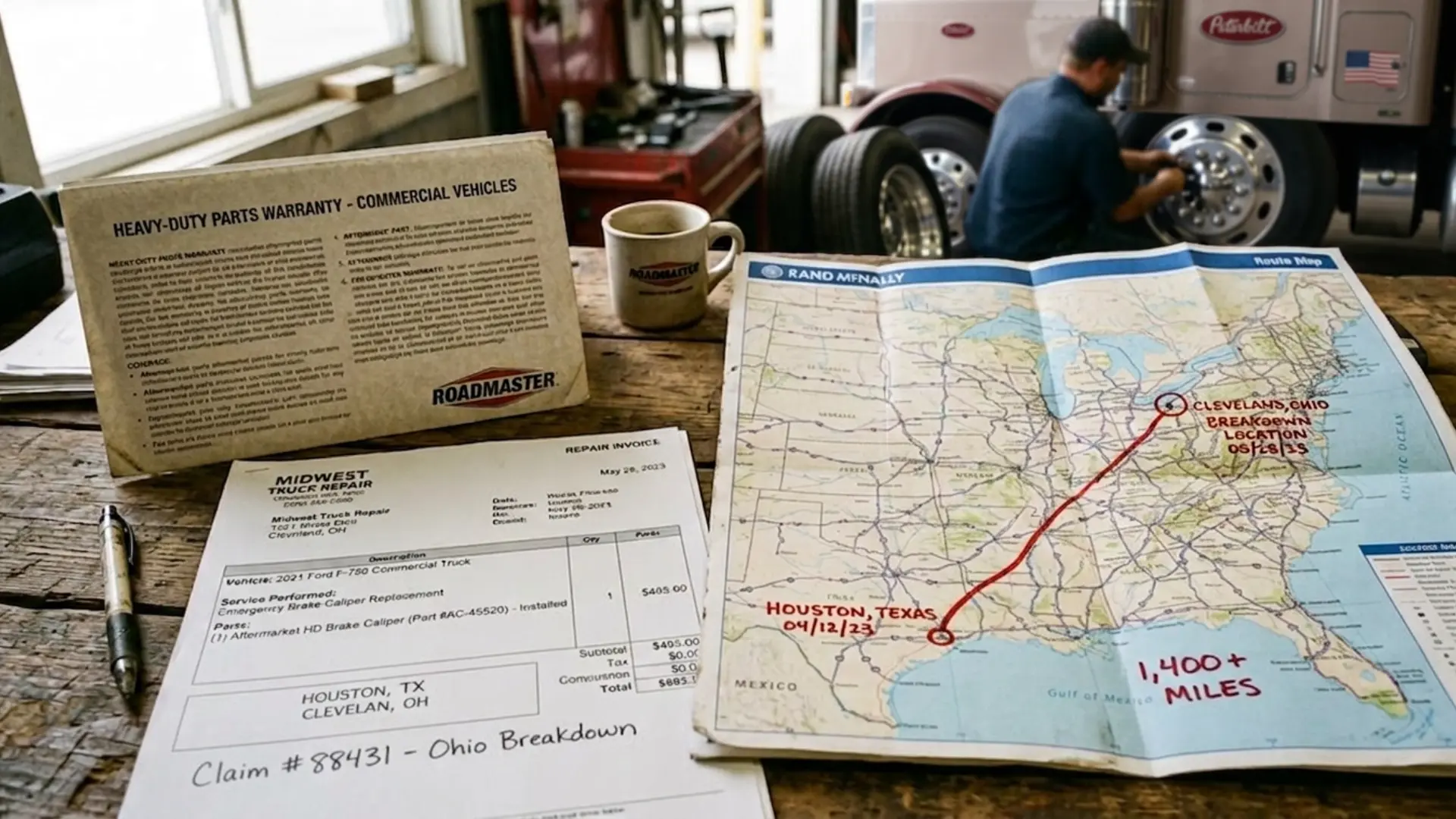

A brake caliper gets replaced during a PM visit at a shop in Dallas. Seven weeks later, the same truck is rolling through Ohio when that caliper fails and the truck goes out of service. The nearest shop can fix it. The question is who pays for it.
If the fleet manager assumes the answer is simple, the warranty documentation the Dallas shop produced will settle the matter quickly. If the invoice from that visit says "brake caliper, aftermarket" with no part number, no supplier name, and no documentation of the warranty terms that came with the part, the fleet is paying out of pocket for a replacement part that may still have been under warranty when the failure happened. Nobody can prove otherwise because nobody recorded the information that a warranty claim requires.
This scenario is not unusual. It is the standard outcome when fleets use outside shops across multiple states and never establish what documentation each shop is required to produce on every parts transaction. Understanding how aftermarket parts warranty actually works on commercial trucks, and what the fleet needs in writing before a part is installed, is what separates a recoverable warranty claim from an unrecoverable parts cost.
Most fleet managers who have dealt with consumer vehicle warranties know the Magnuson-Moss Warranty Act by reputation: federal law prohibits manufacturers from voiding a consumer warranty just because an aftermarket part was used. The burden is on the manufacturer to prove the aftermarket part caused the failure. That protection is real, and it matters for consumer vehicles.
It does not apply to commercial trucks. Marc Karon, legislative affairs chairman for the Commercial Vehicle Solutions Network and president of Total Truck Parts, stated this directly in a Trucking Info commentary: under current federal law, warranties offered by commercial vehicle manufacturers may be arbitrarily denied simply because the truck owner did not source the repair or maintenance part from the authorized dealer. A commercial truck fleet does not have the federal consumer protection backstop that a passenger car owner has when it comes to aftermarket parts and warranty coverage.
The practical consequence is that when a shop installs an aftermarket part on a commercial truck under OEM warranty, the OEM has stronger grounds to deny a warranty claim on that system than they would for a consumer product. This does not mean aftermarket parts are the wrong choice for a commercial fleet. For trucks outside OEM warranty, which applies to the majority of a Class 8 truck's operational life given that OEM coverage typically ends at 100,000 miles on basic components and 250,000 miles on powertrain, aftermarket parts are standard practice. The point is that the warranty coverage for the part itself comes entirely from the aftermarket supplier's warranty, not from any federal protection that requires it to be honored.
Aftermarket parts for Class 8 trucks typically carry warranties ranging from 12 months to limited lifetime coverage depending on the component type and the supplier. Drivetrain-adjacent components from major aftermarket suppliers, including Eaton, Dana, and Horton, are engineered and tested against OEM specifications and carry warranty terms comparable to OEM part warranties for similar components. According to Trucks Parts and Service's coverage of how suppliers determine warranty length, most major aftermarket suppliers parallel OEM warranty terms because their parts are designed and built to meet OEM assembly requirements, and the testing process validates the expected service life under those conditions.
The warranty coverage on any specific aftermarket part is only as useful as the documentation the installing shop produces. A warranty on a part that was installed but not identified by part number, supplier, and date of installation cannot be claimed. The part failed, but the fleet cannot demonstrate which supplier is responsible because the work order does not name them. This is where the documentation failure becomes a direct financial loss.
What a complete parts transaction record looks like for a single component replacement: the part number from the supplier's catalog, the supplier's name and part warranty terms (duration and conditions), the date of installation, the vehicle's mileage at installation, and the technician who performed the installation. That set of information is what a warranty claim processes against. An invoice that does not contain it is not a warranty-enabling document. It is a billing record.
The FMCSA fleet maintenance records article covers the federal documentation requirements for replacement parts in maintenance records, specifically that part numbers and quantities are required on service records to satisfy 49 CFR Part 396 audit standards. The overlap between FMCSA compliance documentation and warranty claim documentation is not coincidental. The same level of specificity that satisfies an auditor also enables a warranty claim. Vague work orders fail both tests.
Even when a part has a valid warranty and the documentation is complete, the fleet faces a second problem specific to trucks that cross state lines: the warranty claim has to be honored at a shop that is not the installing shop, often hundreds or thousands of miles away.
SelecTrucks, which operates nationwide commercial truck warranty programs, identifies this directly as the most operationally significant warranty question for over-the-road fleets: without confirmed nationwide repair access, a fleet with a valid warranty claim may struggle to find a repair facility that will accept and process that specific supplier's warranty. The result is that the fleet pays for the repair out of pocket and attempts to recover the cost through a reimbursement claim submitted after the fact. Whether that reimbursement is approved, how long it takes, and whether the documentation the repairing shop produced satisfies the supplier's claim requirements are all variables the fleet does not control.
The Heavy Duty Parts Report's fleet procurement guidance identifies national warranty coverage as one of the primary concerns fleet managers should raise with any parts supplier: specifically, how the warranty functions when the truck has left the region where the repair was performed. For a fleet running a single corridor out of one region, this question has limited relevance. For a fleet dispatching across multiple states, it is the question that determines whether aftermarket parts warranty has any real value during a roadside failure or whether it only applies to the uncommon scenario where the truck breaks down near the shop that installed the part.
The practical test for national coverage: ask the supplier, before the part is installed, whether the warranty can be processed at any licensed repair facility in the United States or whether it requires returning to an authorized shop in the supplier's network. If the answer involves network restrictions, the fleet should understand that coverage before the truck leaves the installing shop's region.
Aftermarket warranty claims for commercial trucks do not process automatically. The underwriter reviews the claim and can deny it based on maintenance history. Chad Lucky, regional service director for National Truck Protection, stated this in Commercial Carrier Journal's coverage of commercial truck warranty claims: "If you haven't been maintaining the truck properly, it will void your warranty." Aftermarket warranty providers require PM records as part of the claim submission, including VIN, date of service, and mileage at each service, to verify that the fleet was maintaining the truck according to the warranty's maintenance requirements before the failure occurred.
This means a fleet that has been using outside shops with inconsistent documentation standards is exposed on two fronts simultaneously: the FMCSA compliance risk from incomplete maintenance records, and the warranty claim risk from the same incomplete records. A warranty claim on a part that failed at 90,000 miles submitted without PM records demonstrating regular service is a claim the underwriter can deny on the grounds that the maintenance requirements were not met.
If your fleet's maintenance documentation currently consists of whatever invoices individual shops produce in their own formats, the warranty claim process will expose that gap at the worst possible time: when a high-cost part fails on the road and the fleet needs to recover that cost quickly.
A coordinated preventive maintenance program that produces consistent documentation across every shop in the network builds the maintenance record that warranty claims depend on, at the same time it builds the compliance record that FMCSA auditors require. These are not separate documentation systems. They are the same documentation, applied consistently, producing two separate forms of protection.
A shop in a vetted network has an established relationship with its parts suppliers. That relationship has practical consequences when a part fails away from the installing shop.
When a fleet uses a coordinated maintenance program through a network where shops have pre-established supplier relationships, the parts installed during service events come with supplier documentation that travels with the vehicle file, not just the shop's own invoice. If a component fails 800 miles from the installing shop, the network has the relationship with the supplier to coordinate the warranty claim on the fleet's behalf rather than leaving the fleet to initiate a claim against a supplier they have no direct relationship with.
By contrast, a fleet routing trucks through whatever shops are convenient at the time gets parts sourced by individual shops from their individual supplier relationships. When the part fails on the other side of the country, the fleet's warranty recovery path runs through the original shop, which may have no motivation to spend hours processing a warranty claim for a truck that is no longer on their lot, and through a supplier the fleet has never dealt with directly.
The difference is not the quality of the parts. Aftermarket parts from established suppliers like Eaton, Dana, and Horton meet OEM specifications and carry comparable warranty terms. The difference is whether the documentation and supplier relationships exist at the fleet coordination level to make the warranty claimable when a failure occurs far from where the part was installed.
What documentation your fleet currently receives on every parts replacement, what warranty terms those parts carry, and whether that coverage can be claimed at any licensed shop in the country are questions worth answering before a high-cost component fails on a remote corridor. The truck parts and tires page covers how parts sourcing works through the vetted partner network, including the supplier relationships that make warranty coordination possible across 48 states. If you want to understand what documentation your fleet's current shops are producing on aftermarket parts transactions and whether it enables warranty claims when failures happen away from home, reach out through the contact page with your fleet profile. That is a more useful conversation with specifics than in the abstract.
This article draws on the following sources: